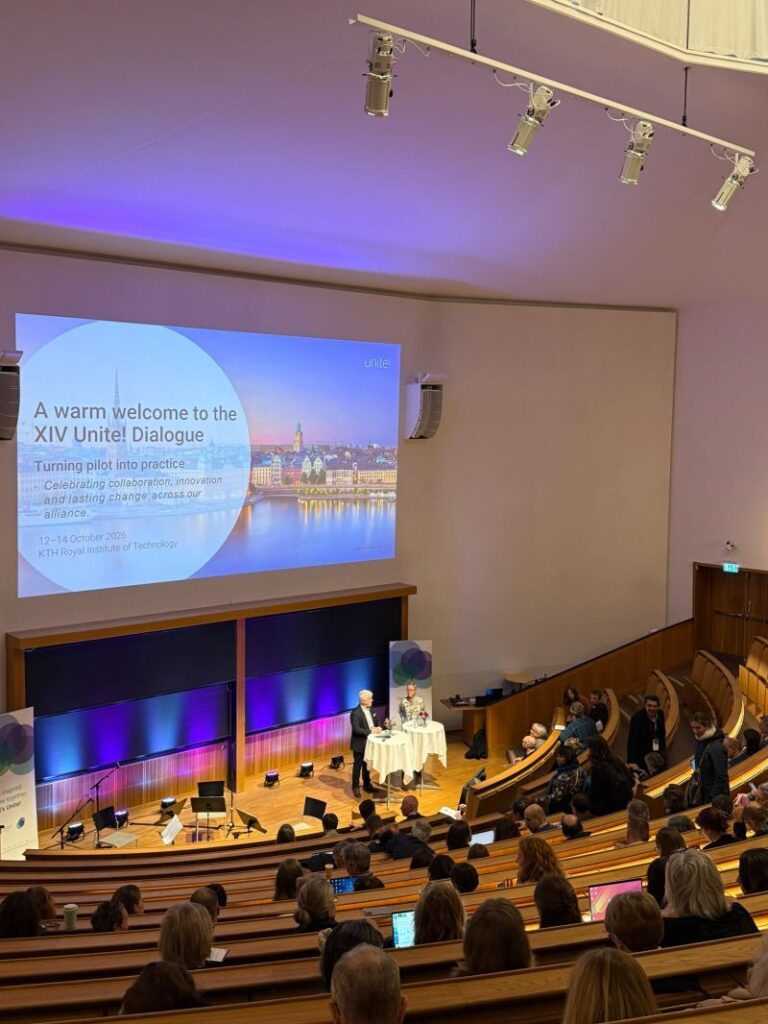
When more than 300 academic leaders, researchers, and innovators gathered in Stockholm for the 14th Unite! Dialogue (October 12–14), a central imperative shaped every discussion: How do we ensure European university collaboration moves beyond intent to deliver tangible scientific and economic impact across all regions?
Organized under the theme “Turning pilot into practice,” the Stockholm Dialogue marked a pivotal shift for the entire alliance. For Unite! Widening, it served as a clear validation of our core mandate: embedding long-term institutional reform, expanding research excellence, and unlocking the full innovation potential of Widening countries across Europe.
Bridging the European R&I Divide
European research excellence cannot reach its full potential if structural disparities persist between innovation leaders and emerging regions. As a dedicated Horizon Europe project running alongside the broader Unite! Alliance, Unite! Widening works to close this gap by transforming how institutions in Widening countries—such as Poland and Portugal—integrate into high-impact European research networks.
With the European Commission’s recent €7.2 million grant supporting the alliance’s next operational phase, the framework for cross-border cooperation is stronger than ever. Across nine partner universities spanning from Finland to Portugal—encompassing 200,000 students and over 80 active joint initiatives—the focus is moving from temporary testing grounds to systemic practice.
For Widening regions, this means establishing real parity in scientific leadership, modernizing technology transfer systems, and creating clear pathways for talented researchers to thrive within their home institutions while engaging seamlessly in European science.
Four Strategic Research Areas Driving Transformation
To deliver concrete results, Unite! Widening has established four Strategic Research Areas designed to align regional strengths with major European policy priorities:
- Health & Biotech:Advancing personalized medicine, digital health, and biomedical engineering (co-led by the University of Lisbon and Wrocław Tech).
- Urban & Resources Sustainability:Addressing climate resilience, clean energy transitions, and urban water management (co-led by Wrocław Tech and the University of Lisbon).
- Circular Economy & Materials: Fostering sustainable manufacturing, green chemistry, and advanced materials for low-carbon economies.
- Digital & Autonomous Technologies: Supporting AI, robotics, and automation systems to drive digital sovereignty and Industry 4.0 readiness.
By co-directing these domains, researchers from Widening institutions are taking an active lead in setting research agendas, shaping Horizon Europe proposals, and directing regional innovation ecosystems.
Leadership in Action: Moving Towards Wrocław 2027
The growing leadership of Widening countries is reflected across the alliance’s governance. With key roles embedded across partner universities—including Wrocław Tech’s Rector, Prof. Arkadiusz Wójs, serving as Unite! Vice-President for Research—Widening perspectives actively inform high-level strategic decisions.
The trajectory set in Stockholm points directly to the next milestone: In May 2027, Wrocław University of Science and Technology will host the 15th Unite! Dialogue. It will be a showcase of how joint research pilots, living labs, and capacity-building schemes initiated under Unite! Widening have matured into permanent, sustainable practices.
By turning strategy into execution, Unite! Widening continues to prove that when European universities share infrastructure, knowledge, and vision, excellence prospers across every corner of the continent.